
Automation Playbooks
Multi-Agent Workflows — When One AI Isn’t Enough
How to chain multiple models for research, writing, verification, and execution
You’ve got one AI doing everything: researching, writing, checking its own work, and publishing. It’s like hiring one person to be the researcher, writer, editor, and fact-checker. No company operates that way. Neither should your AI workflows. Multi-agent workflows let you assign specialized roles to different AI models—each focused on what it does best—then chain them together into systems that actually scale.
The Single-Agent Problem
Most people using AI today operate in what researchers call “zero-shot” mode: you give the model a prompt, it generates a response, done. This works fine for simple tasks. But the moment you need complex, multi-step work—research that feeds into writing that needs verification before publishing—a single model starts to struggle.
The issue isn’t intelligence. It’s attention. A single agent trying to research, write, and verify its own work is essentially marking its own homework. It doesn’t catch its own blind spots because it created them.
As AI researcher Andrew Ng highlighted in his Sequoia AI Ascent 2024 talk, agentic workflows with iterative processes and multi-agent collaboration dramatically outperform single-shot approaches. On the HumanEval coding benchmark, GPT-3.5 wrapped in an agentic workflow scored 95.1%—surpassing GPT-4’s 67% in zero-shot mode. The architecture matters as much as the model.
The Four Patterns That Power Multi-Agent Systems
AI researcher Andrew Ng identified four design patterns that drive effective multi-agent workflows. These aren’t theoretical—they’re the building blocks showing up in every serious agentic system being built today.
Reflection. Instead of generating output once, an agent critiques its own work and iterates. You might have one agent write code, then the same agent (or a separate critic agent) review it for bugs, then the original agent revise based on feedback. This loop can run multiple times until quality thresholds are met. It’s automated code review, but for any content type.
Tool Use. Agents don’t just generate text—they interact with external systems. They can search the web, query databases, execute code, send emails, or call APIs. This transforms them from fancy text generators into actual process executors. The agent decides which tools to use and when, based on the task at hand.
Planning. For complex tasks, an agent breaks the work into steps before executing. Instead of trying to answer “write me a research report on market trends” in one shot, a planner agent might decompose that into: gather data sources, extract key statistics, identify trends, draft sections, compile report. Each step can then be assigned to appropriate agents or tools.
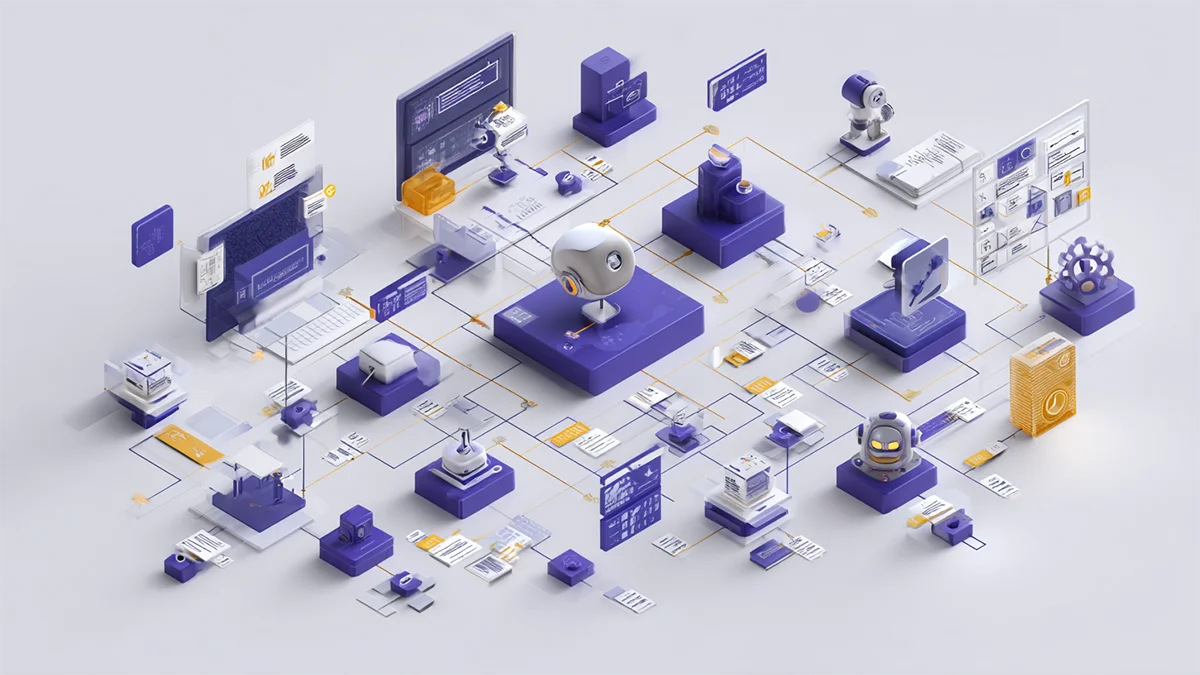
Multi-Agent Collaboration. Different agents with different specializations work together. One researches, one writes, one verifies facts, one checks for brand voice. They pass work between each other like a team of specialists. This is where the real power emerges—you’re not limited by what any single model can do.
The Multi-Agent Framework Landscape
Several frameworks have emerged to make multi-agent workflows practical. Each takes a different approach to the same core challenge: how do you coordinate multiple AI agents working together?
LangGraph uses a graph-based architecture where each agent is a node and connections define how work flows between them. You get precise control over branching, conditionals, and state management. It’s powerful for complex workflows with lots of decision points, but the learning curve is steep.
CrewAI takes a role-based approach. You define agents like employees with specific jobs—researcher, writer, editor—and the framework handles coordination. It’s intuitive for workflows that mirror how human teams actually work, and it’s one of the fastest ways to get a multi-agent system running.
AutoGen from Microsoft treats everything as conversation between agents. Agents chat back and forth, passing messages and coordinating through dialogue. This works well for dynamic scenarios where agents need to negotiate or adapt on the fly, but orchestration can get complex as systems grow.
OpenAI Agents SDK launched in March 2025 with a lightweight approach: minimal abstractions, clear handoffs between agents, and built-in guardrails for safety. It’s designed to be accessible for developers new to agent development while still supporting production workflows.
The right choice depends on your use case. Graph-based solutions like LangGraph give you precise control. Conversation-based solutions like AutoGen give you flexibility. Role-based solutions like CrewAI give you speed to implementation.
A Practical Multi-Agent Architecture for Content
Let’s get concrete. Here’s how a multi-agent workflow might handle content generation end-to-end:
Research Agent. Takes a topic and gathers information. Searches the web, pulls from knowledge bases, identifies key sources. Output: structured research notes with citations.
Planning Agent. Takes research notes and creates a content outline. Decides structure, identifies key points to cover, establishes flow. Output: detailed outline with section breakdowns.
Writing Agent. Takes the outline and research, generates draft content. Focused purely on writing—not fact-checking, not strategy. Output: first draft.
Verification Agent. Takes the draft and checks it against source material. Flags unsupported claims, identifies potential hallucinations, verifies factual accuracy. Output: verification report with flagged issues.
Brand Agent. Takes the draft and checks against style guide and brand voice. Ensures tone consistency, catches banned phrases, verifies formatting standards. Output: brand compliance report.
Revision Agent. Takes the draft plus both reports, makes necessary fixes. Only addresses flagged issues—doesn’t rewrite what’s already working. Output: revised draft.
Each agent has one job. The system coordinates handoffs. Verification happens systematically, not hopefully. The result: content that’s been researched, written, fact-checked, and brand-verified before any human sees it.
Why Different Models for Different Agents
Here’s where multi-agent workflows get interesting: you don’t have to use the same model for every agent.
A research agent might use a model with strong retrieval and synthesis capabilities. A writing agent might use a model known for creative, engaging prose. A verification agent might use a model that’s particularly good at logical reasoning and fact-checking.
This “multi-model consortium” approach has real advantages. Research from Cambridge Consultants (“Teaming LLMs to Detect and Mitigate Hallucinations,” 2025) shows that combining responses from multiple LLMs with different training data and architectures—through techniques like consortium voting and entropy measurement—produces higher accuracy and reduces hallucination risk compared to relying on any single model. Heterogeneous models are less likely to hallucinate in the same way, so the consensus-driven approach catches errors that individual models miss.
It also provides resilience. If one model provider has an outage or changes their API, your workflow doesn’t completely break. The architectural separation means you can swap models without rebuilding the entire system.
When to Use Multi-Agent Workflows
- Complex content pipelines where research, writing, and verification need to happen systematically rather than hoping one model catches everything
- High-stakes outputs where factual accuracy matters and you can’t afford hallucinations—legal documents, medical content, financial analysis
- Scale production where you need consistent quality across hundreds of pieces, not artisanal one-offs
- Brand-critical content where tone, style, and compliance must be verified before publication
- Workflows requiring external data where agents need to search, query databases, or interact with APIs as part of the process
Starting Small: Your First Multi-Agent Workflow
Don’t try to build a six-agent system on day one. Start with two agents doing one handoff.
The simplest multi-agent pattern is Generator → Critic. One agent creates content. A second agent reviews it against specific criteria. The first agent revises based on feedback. Even this basic loop produces meaningfully better output than single-shot generation.
Once that’s working, add a third agent. Maybe a planner that runs before the generator, or a brand checker that runs after the critic. Each addition should solve a specific problem you’re actually having—not a theoretical one.
The frameworks mentioned earlier all support this incremental approach. You don’t have to design the entire system upfront. Build, test, expand.
The Multi-Agent Mindset
Multi-agent workflows represent a shift in how we think about AI automation. Instead of asking “what can this model do?” you’re asking “how should work flow through a system of specialized agents?”
According to MarketsandMarkets, the agentic AI market was $5.1 billion in 2024 and is projected to grow at a 44.8% CAGR, reaching $47.1 billion by 2030. This isn’t hype—it’s organizations discovering that orchestrated AI systems outperform isolated models for complex, repeatable work.
The question isn’t whether to adopt multi-agent approaches. It’s how quickly you can move from single-model prompting to systematic workflows where multiple agents research, generate, verify, and execute—without you being the bottleneck at every step.